Tuesday, December 13, 2011

Copper Hills Show - A Saturday Happening

One of the goals of our model railroad club, Rail Roadrunners of Yuma, is to take the hobby to the public in schools, homes and fairs.

This afternoon, Marv, Ron and I took two layouts to Copper Hills Assisted Living Facility.  This is about our fourth visit and we shared 4 scales, N, HO, O and G.

Ron
  
Here Ron sits comfortably, overseeing his domain, an N scale layout on a 2'x4' Homosote board obtained from Marv, in a wood frame made by me, running on track relaid by Marv.  Encouraged by my Clinic, Building a Diorama, available elsewhere on this blog, Ron and his wife are adding scenery and structures to the small, portable, layout. 

 Glen
This was Camp Swampy, after the first major changes, removing the flex track and turnouts that seemed to cause derailments.  I had bought a batch of Bachmann EZ Trac and made a simple 22" radius circle.  The white shows where the old track was.  The dark green spot in the center was where the old flagpole stood.
After a week of work I ended with this, a double track, two level circle layout.  The upper level is  1" extruded foam cut to fit inside the 22" radius circle and able to still hold a circle of 18" radius.  Most of the buildings are card models downloaded from the internet, printed on 110# card stock and assembled with glue.  The log cabin and several buildings were scratch built by me.

Another Glen, a Snowbird from Canada, brought this G scale battery powered model to one of our meetings to see if we could help him get it running.  With his permission I took it home and worked at rounding the plastic bearings on the driver axles to allow it to start and run in forward and reverse.  The tender has four orange buttons you press to make different calls, bells, whistles chuffs and running sounds, quit an attention getter.  On a sorry note, I opened the rear door of the SUV in the rain and the box with this and other items fell out.  I have not had the nerve to look yet.

This colorful little train is On30, O scale train running on HO track.  The coach painting is based on Thomas Kincade paintings.  I let this run on the upper level for the entire 2 hour show.


Marv

Marv had a relaxing day, working mostly to help Ron and me move everything in and out.  He also pushed the orange buttons on the G scale engine to create sounds and motions to attract attention. 

Come join us Saturday mornings from about 9 am till noon for our regular weekly meeting at the Community Christian Church, 6480 East Highway 95, Yuma, AZ.  Pull around back, we are in the South building.


This is an earlier shot of the 5'x10' HO layout we are presently working on during the weekly meetings.  It will be a 2 level layout with 23" minimum curves and 2% maximum grades.  We have the lower level sub-roadbed finished and supported well.  The upper level starts on 12-17-2011.  Be there!


Armchair

Thursday, December 8, 2011

Some NEW model railroad and Club news.

I have been finishing the water tank I started a couple of years ago.  I started with a small, 4" diameter peanut can, wrapped it with scribed card material and secured that with 11 bands of .020" wire with 2 twisted "turnbuckles" each.  The support legs are hefty to support the estimated 500,000 pound load of the 60,000 gallons and tank.


The 8 sided roof is covered with hand cut shingle strips.


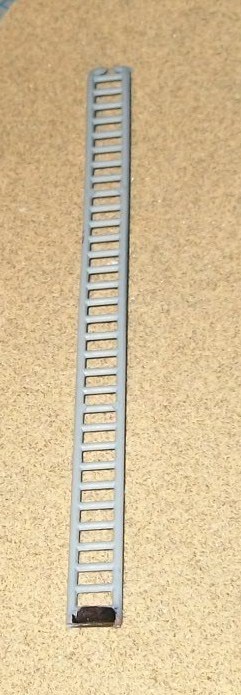
I still have to attach the spout, ladder and top finial.


Monday, September 26, 2011

Wednesday, September 14, 2011

For the Robotic, Geek, Techies

For those of you who may find my postings a little shallow I want to introduce you to my oldest son's site, http://henrytherobot.com  .   Tim is designing and building a robot of a puppy that thinks and acts like a puppy.  It is beyond me, but I hope some of you will find it interesting.

Armchair

Sunday, September 11, 2011

Dark and Not So Hot in Yuma

As many of you (in the USA) may have heard, we had a MAJOR power blackout Sept. 8, 2011, in the Southwest USA covering San Diego and Orange county California, Northern Baja Mexico and Yuma county Arizona.  With temperatures in the low 100's F we lost our NEEDED (for modern society) air-conditioning.  Much of the business community shut down with no electricity for lights and operations.  People, like me, were driving miles around looking for ice, gasoline, and a place to eat or stay for the night.

With the gas pumps out of power it reminded me of my years in Sierra Leone, West Africa, 1978-1979.  Over there the power was questionable but you were always able to get gas.  The stations would attach a crank to the pump and have a young boy crank.  People get ingenious when they have to and when the governments don't get in their way.

Summer must be about over as we are looking forward to 4 or 5 days of below 100F temps.  The winter visitors will start coming back in October and the rest of you can "eat your hearts out" come January when we have days in the 70'sF.

Armchair 

Wednesday, September 7, 2011

Aerospace Modeling


As a child growing up in the 1940's and 1950's we had no real understanding of space flight.  Sure, we had Buck Rogers and Space Cadets, but Sky King was real life to us, sitting in front of the radio each afternoon.  Dick Tracy had his wrist radio and we had "Atom Bomb" rings with a secret message compartment.  Many of us played cowboys and Indians, had scooters, roller skates, balsa wood gliders and made friends by throwing rocks at each other (an early form of male bonding).  Our early life knowledge of solid fuel rockets was learned on the 4th of July.  My first model airplane was a hard rubber, silhouette model used the the Navy for training.  The late 1940's found the war over, cars had radios and gas was plentiful; 1950 had us at war in Korea.

In the fifth grade I bought my first airplane kit, the Bell X-1 rocket plane piloted by Chuck Yeager.  It was a solid wood model about 6 inches long.  That was followed shortly by a control line model and a .049 cubic inch gas engine.  The plane and engine never mated, but the engine did test runs nailed down to a bench on the back porch.  Many plastic models followed from time to time.

Science was a hot subject; crystal set radios, chemistry sets, electric toys, mostly paid for with paper routes or collecting scrap metal and pop bottles.

Just a start here, what did YOU do before the age of electronics?

Armchair

Tuesday, September 6, 2011

Lionel O Scale Engine Repair

Had a new guy stop by the Club a couple of Saturdays ago with his childhood railroad train, a 3 rail O scale Lionel from about 1949.  It had bounced around the family for years and finally returned to Harvey.  He had a couple of boxes of cars, track, transformer with reverse and horn buttons.   We tried getting it to run but mostly it would just hum.  Having never worked on O scale before I was interested in getting into the workings, so with Harvey's permission took it home for a better look-see.

Click on Pics to enlarge
This is the Lionel O scale "Scout" locomotive with the rear truck removed.   The 3 rail track is O gauge, 1.25" center to center of the outside rails.  The two long screws that hold the motor/drive assembly are at the end of the track.


Dis-assembly is rather straight forward, one screw on the bottom removes the trailing (rear),  truck, and two small screws on the bottom remove the lead truck, headlight assembly and piston guides.  The motor/drive assembly is held in place by two long screws located on the side of the engine.


The "Motor/Drive Assembly" is shown removed for service.  The motor itself sits crosswise in the engine and drives a gear train to the drivers.  The connecting rod between the drivers is for looks only, the drivers are geared together.  The copper windings in the center are the electromagnet that forms the motor "Field", the vertical coil on the left is the "E" "Reversing Solenoid" with the three position "Reversing Lever" at the rear.  Lionel locomotives used 10 to 18 volt AC current, no + or - polarity to the rails as in HO scale DC operation.  In "Normal" operation each throttle "Off/On" operation would reverse the direction of the locomotive.  A "Second" position would allow constant one way direction in forward or reverse.  The "Third" or "Off" position, would disconnect the locomotive from the power, allowing it to remain on the track while other locomotives operated.


This left side view shows the motor "Brushes" between the drivers and the motor shaft between the brushes.  The unpainted plate above the rear driver has a slot that guides the "E" Reversing Solenoid. 

Armchair      Sept. 6, 2011
               Check out additions to Our Model Railroad Club page on the left.